For reservations to experience “nkwiluntàmën: I long for it; I am lonesome for it (such as the sound of a drum)” by Indigenous artist Nathan Young, please go to https://nkwiluntamen.com/
Many of you may not realize how much time and research goes into crafting the historical outfits worn by our Pennsbury Manor Interpreters. These reproductions are all based on original artifacts, paintings, and sketches in order to honor the people whose stories we tell. It’s a constant evolution, but we are working very hard to make sure each item (down to your pins and socks!) are as close as we can get to 17th-century originals. In many cases, we try to copy the same styles and silhouettes as real 17th-century people, as we have done here with this 1687 London strawberry seller:
We would like to offer our sincerest thanks to the army of interns that have offered their time and talents to Pennsbury over the last 8 months. Often volunteers don’t realize how much behind-the-scenes work happens at Pennsbury, and these 8 students have been invaluable in working on projects in all sorts of areas, in addition to giving tours and helping with special events! Read on to hear about their adventures.
Maggie Lee – A rising senior at the University of Delaware, Maggie spent her winter break last January working on ideas for revamping our walking tour and adding seasonal interpretive information. We look forward to using her research in our new comprehensive visitor brochure, coming this fall.
Kelly Cole – Kelly spent her spring semester internship as a graduate student from the University of the Arts working with Diane Nadler and our new exhibit. Using her museum education skills, she developed a series of teacher activities for schools to incorporate into their field trips. These activities will be featured in a teacher resource section on our newly redesigned website this fall.
Ruth Lonvick – Another student from the University of the Arts, Ruth decided to incorporate her thesis work on gardens and educational programs into her summer internship with Mike Johnson. In addition to helping with summer planting and garden maintenance, she researched and developed a wonderful interpretive signage system for the Kitchen Garden which we plan to implement this fall.
Danielle Lehr – Danielle, an undergraduate student at West Chester University, was also in the gardens helping Mike and Ruth with planting, weeding, and lots of mowing! She also assisted with Ruth’s plant research and started a new blog featurette, “The Country Life,” which can be read at this link: http://pennsburymanor.wordpress.com/category/the-country-life/
Lloyd Frisone – As our third graduate student from the University of the Arts, Lloyd wanted to use his museum communications training and assist Tabitha Dardes with Pennsbury’s public relations projects. This included putting together a schedule of daily Facebook and Twitter posts with event updates, fun history facts, and a weekly promotional lottery. He also developed a press kit for Pennsbury, worked on the 2011 brochure, developing some ideas for our new brochure design, and writing a press release for our exhibit award.
Danielle Straub – Danni spent her summer off from the undergraduate program at the University of Pittsburgh learning about the secret world of Collections Care! Her curatorial work with Todd Galle included writing acquisition recommendations, adding object photography to the files, developing exhibit scripting, and researching artifacts. Some of her work on our maps was featured in the Volunteer Blog featurette “Exploring the Artifacts” – click the link to catch up on her work: http://pennsburymanor.wordpress.com/category/exploring-the-artifacts/ .
Joshua Martin – As Hannah Howard’s summer intern, Josh (an undergraduate student from Kutztown University) was asked to research and develop some ideas for revamping and growing the Youth Volunteering Program at Pennsbury. In addition to helping with the summer camps and volunteer picnic, Josh learned about current program strengths and weaknesses, visited other sites to learn about innovative techniques, and compiled background research. His final report and recommendations offer some exciting possibilities that we will work to implement next spring and summer with Josh’s continuing involvement.
Jennifer Martin – Apparently we didn’t scare her away during her first summer at Pennsbury, because Shippensburg University student Jenn was back again this year! In addition to several small projects around the Visitor Center, Jenn once again took charge of our Summer Camps and they were a smashing success, almost double the campers from 2010. Along with a continuing word-of-mouth campaign from the happy parents, we hope to really promote our 2012 camps and give Jenn even MORE campers to wrangle!
As children get ready to return to school, let’s take a look at Penn’s vision for schooling his own children. This is from a letter to his wife Gulielma written as he prepared to leave for America 1682. He is setting everything in order, just in case “I should never see you more in this world”:
For their learning, be liberal. Spare no cost, for by such parsimony all is lost that is saved; but let it be useful knowledge, such as consistent with truth and godliness, not cherishing a vain conversation or idle mind, but ingenuity mixed with industry is good for the body and mind too. I recommend the useful parts of mathematics, as building houses or ships, measuring, surveying, dialing*, navigation, etc.; but agriculture is especially in my eye. Let my children by husbandmen and housewives. It is industrious, healthy, honest and of good example…It is commendable in the princes of Germany, and [the] nobles of that empire, that they have all their children instructed in some useful occupation. Rather keep an ingenious person in the house to teach them than send them to schools, too many evil impressions being commonly received there. Be sure to observe their genius and don’t cross it as to learning. Let them not dwell too long on one thing, but let their change be agreeable, and all their diversions have some little bodily labor in them.
In the third post for our new series The Country Life, we continue our look into the Kitchen Garden’s herb collection (check out our posts on Lemon Balm and Rosemary). Here is one of my favorites…
Lavender (Lavandula): Visitors will often recognize this herb’s soft, purple flowers and many will welcome the chance to smell it. Colonists also enjoyed lavender’s scent and used it as a perfume for clothing. They also recognized the value of aromatherapy. Lavender’s aroma was used to ease headaches and “giddiness.” The plant’s flowers, leaves, and seeds were also consumed to ward off fainting and joint pain.
I just read a great article from the blog Two Nerdy History Girls that I just had to share. This is an interesting (and usually well-researched) blog written by a couple historical fiction writers, and it’s always a good read for those who enjoy learning about historical clothing and lifestyle.
The article that inspired me to post is on 18th-century ladies’ stays and how to lace them. Follow this link to see their article, which features images of a Colonial Williamsburg interpreter putting on her own stays! For anyone who has tried wearing REAL stays (not those torturous Victorian corsets), getting into them is the most difficult part. But once you’ve done it a few times, it gets much easier and FASTER – I’m speaking from my own recent experience!!
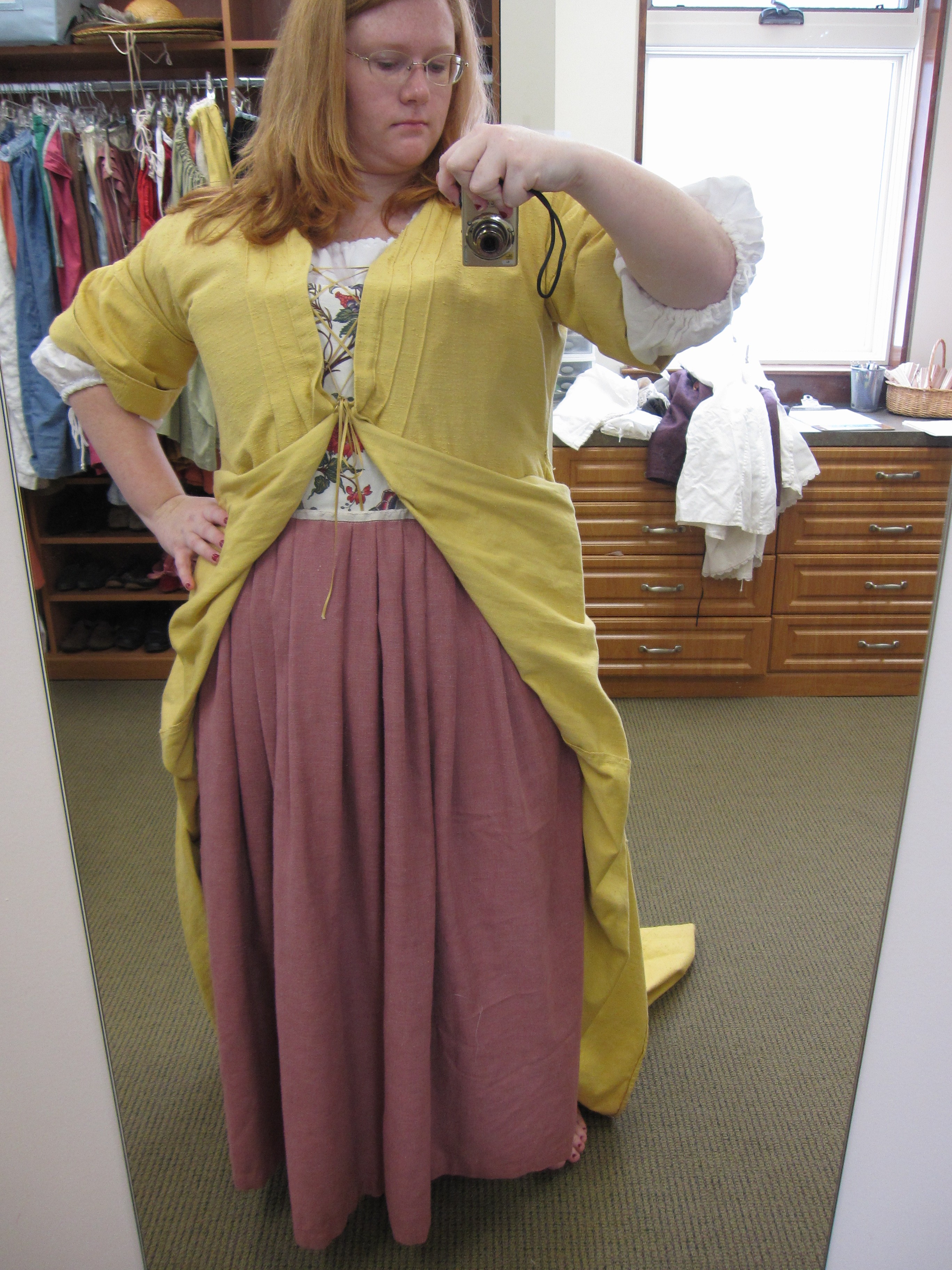
The images above and below are of my first attempt to make stays using a pattern from Reconstructing History. They are definitely amateur, full boned with a mixture of metal and reed pieces. I also made slight changes to the pattern, and we are working on resolving But they work and have held up admirably, and if someone who had been sewing for less than 6 months could do this, ANYONE CAN.
Trust me ladies, the time spent getting into your stays is worth it for two reasons: 1) in my opinion, they are actually comfortable and give some great back support, and 2) it completely CHANGES how you look and move in your period clothing. I will offer up myself on the altar of the Guinea Pig. Check these shots of me in my modern “foundation garments” and then with my circa 1700 Stays…
See the difference! It changes your silhouette completely!! In my stays, suddenly the gowns that WERE hard to find in my size and felt awkward to wear became the right size and a good fit! I can’t encourage you enough to try them. You will notice a difference in how you feel, how you walk, stand, sit… and the visitor will notice too.
Pennsbury is starting to make our own stays and will slowly be increasing our collection. They will be partly-boned with bendable reeds, so that interpreter and craft demonstrators will have the flexibility they need to move and work. In fact, we will eventually have enough for all female volunteers to be able to wear stays! Our standards for researched authenticity have always been high, and we’re working hard and taking our clothing program to the next level. You all work so hard to learn your informative talks and trade skills… our clothing volunteers want you to know you’re dressed in well-researched and well-made reproductions!!
Stay tuned for more posts on stays and other new clothing items in the collection!
Check out the new promotional video by the Bucks County Visitors Bureau! Look for several staff cameos and some great images of volunteer interpreters. A big THANK-YOU definitely goes out to everyone at VisitBucksCounty.com for their hard work. It looks great!!
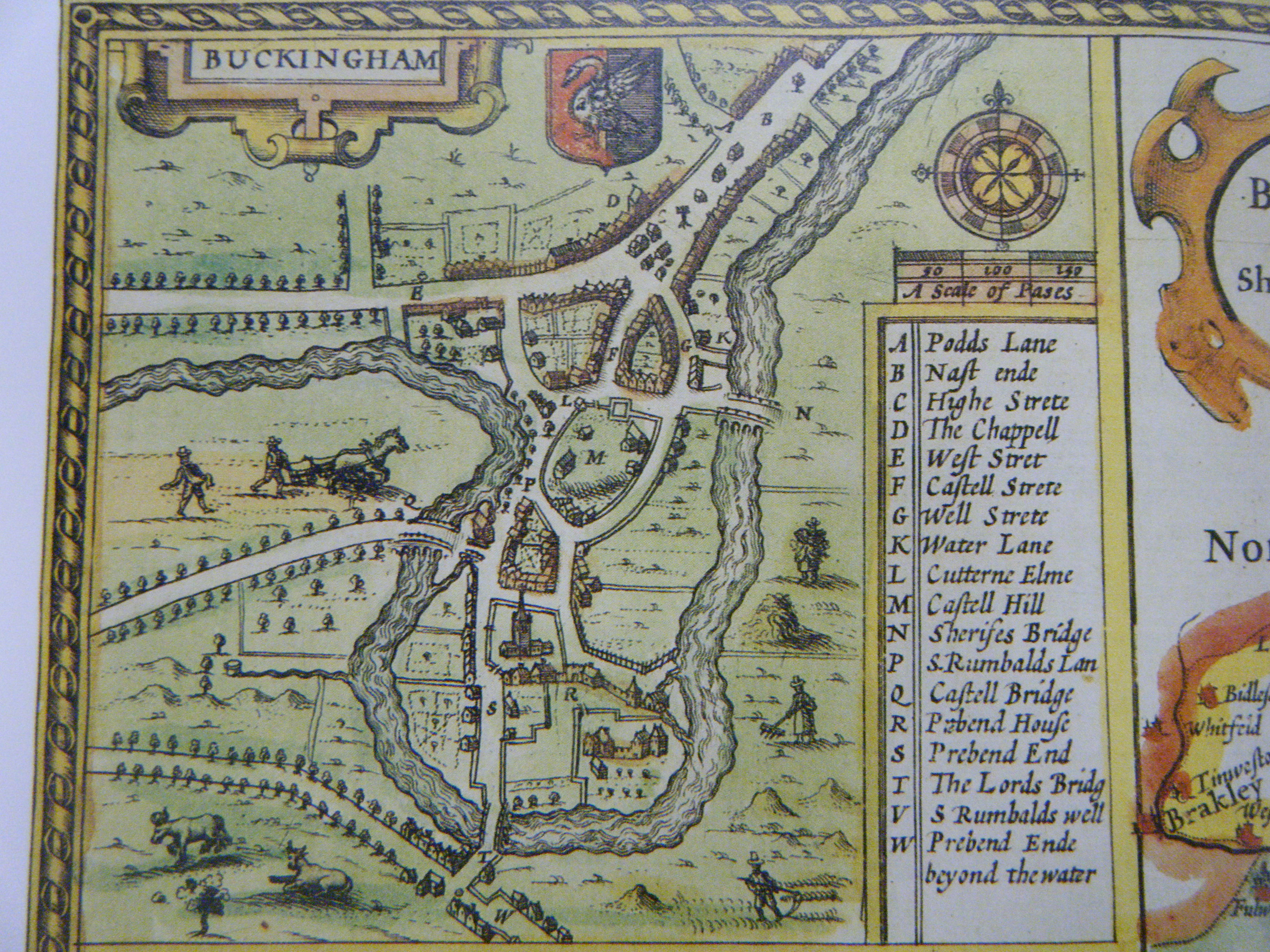
Continuing our exploration of 17th-century maps (see my last featurette here), we look at yet another map in the Manor House:
Map of Buckinghamshire – by Danielle Straub
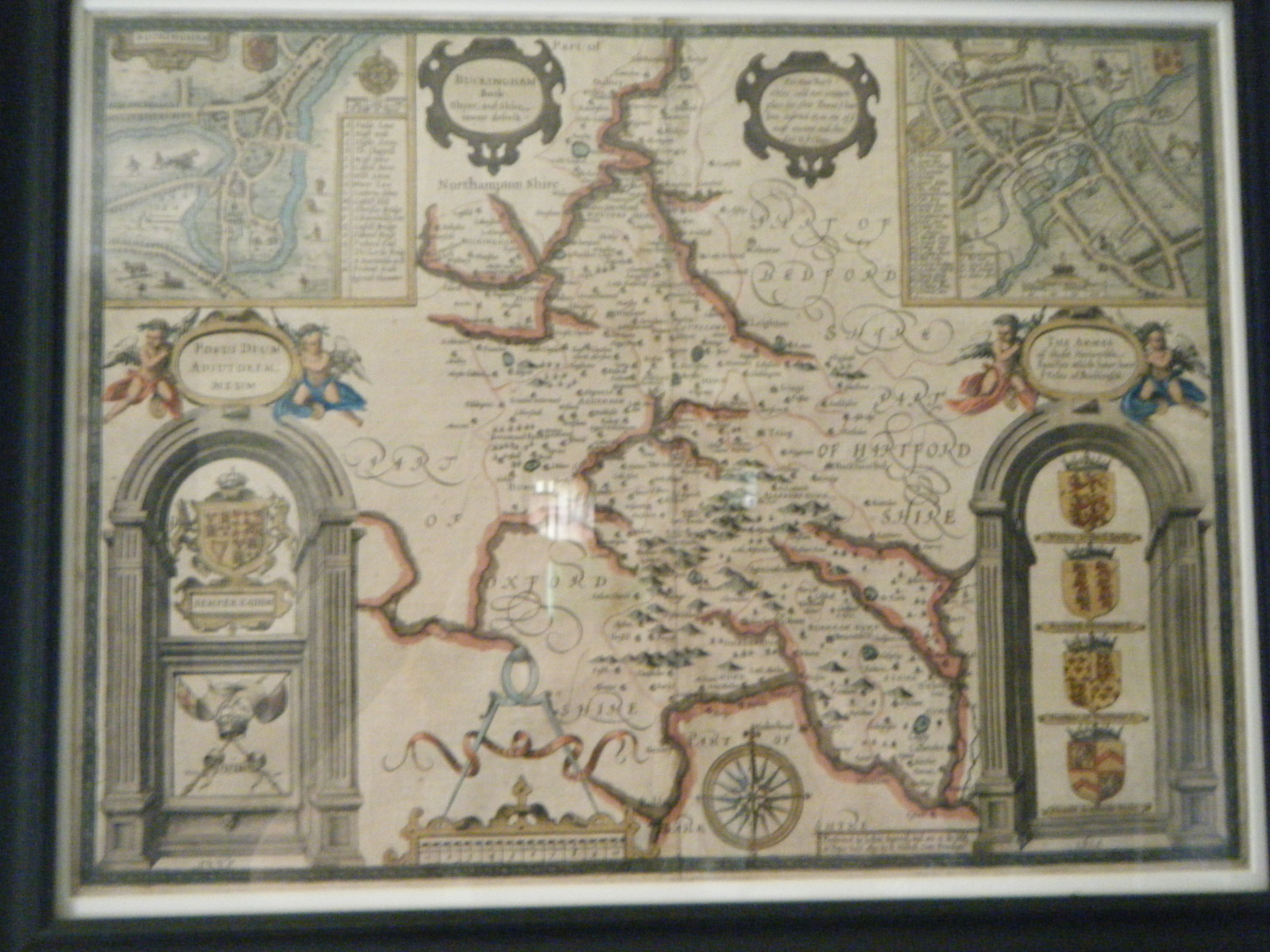
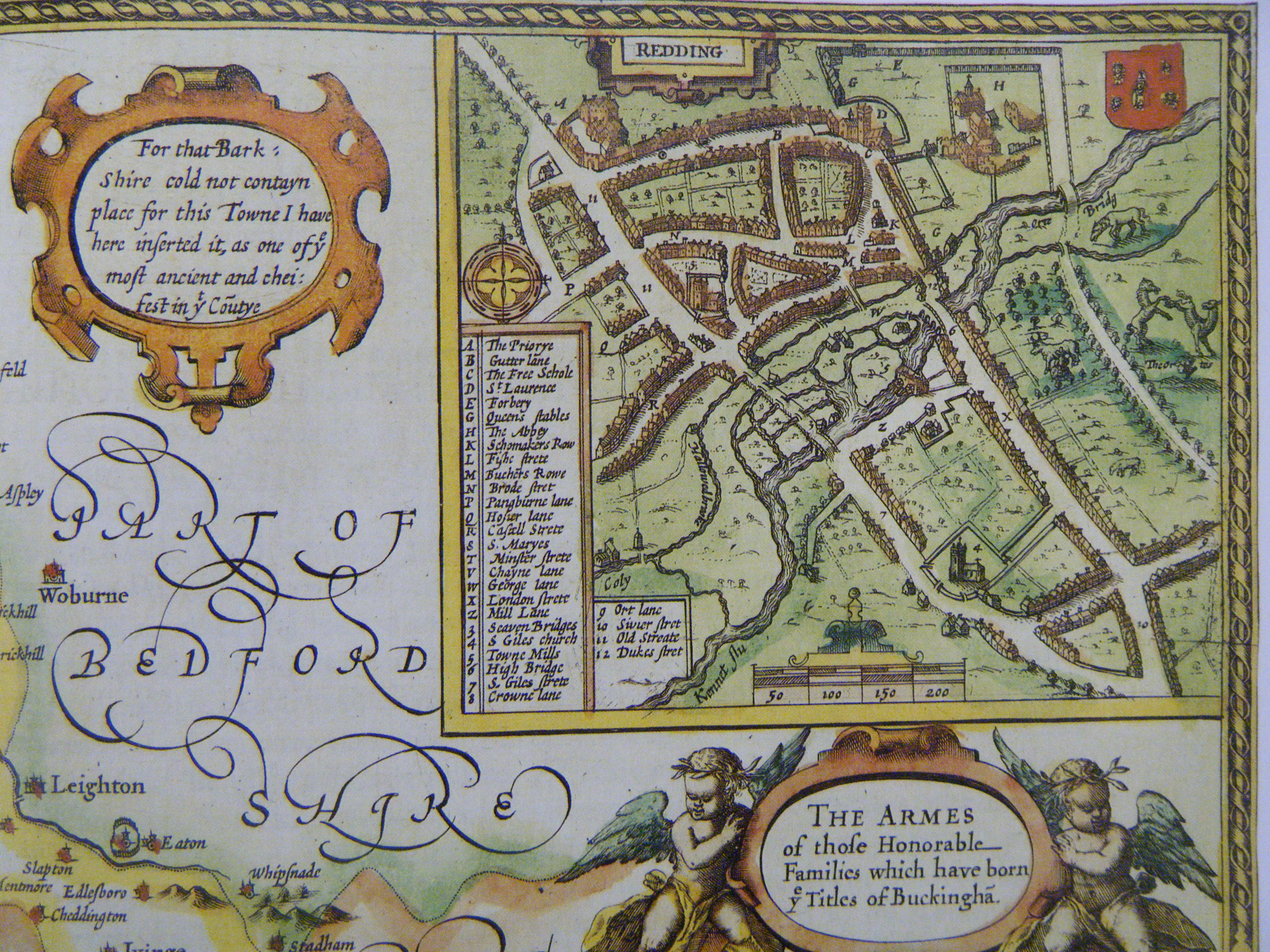
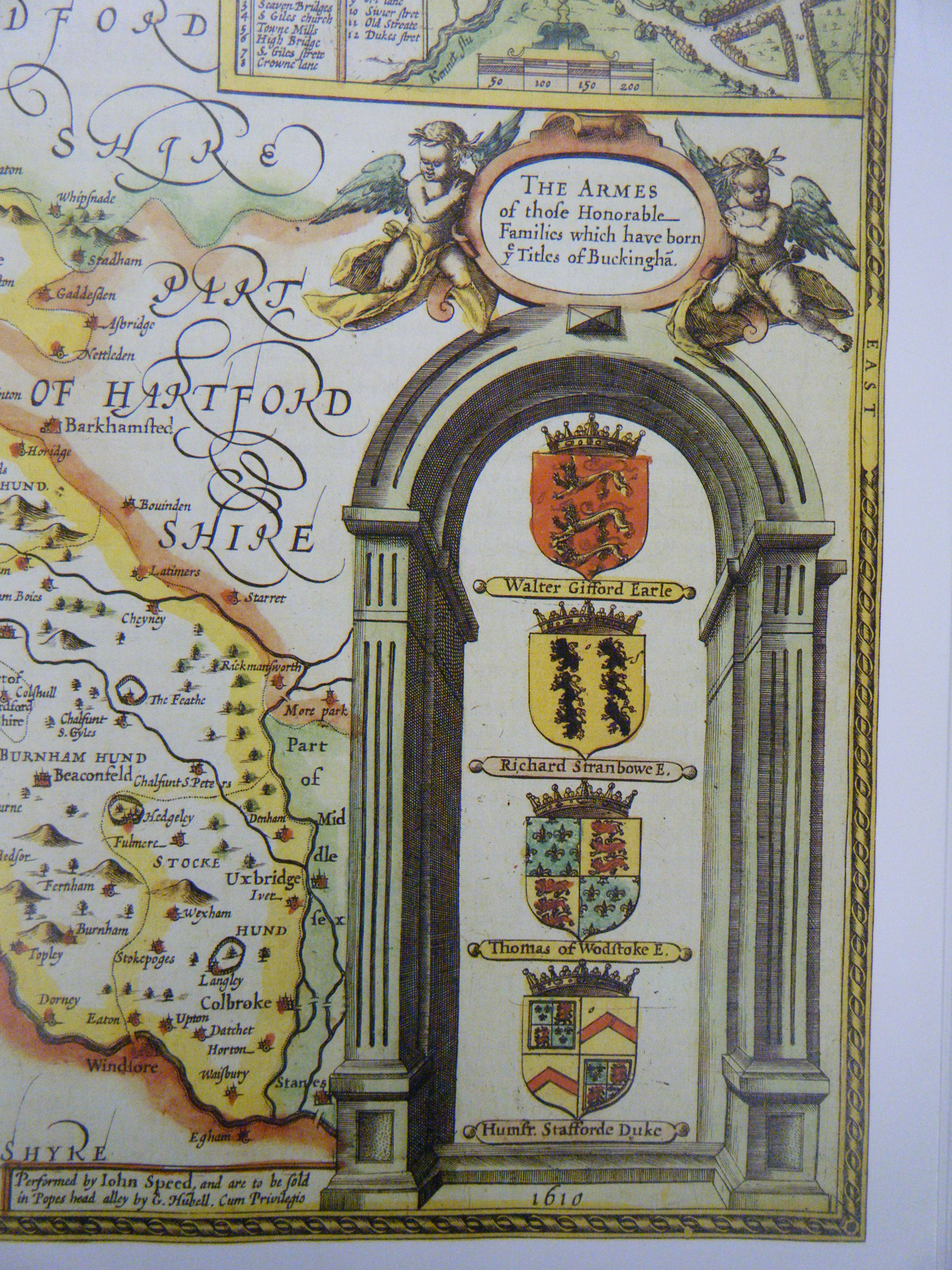
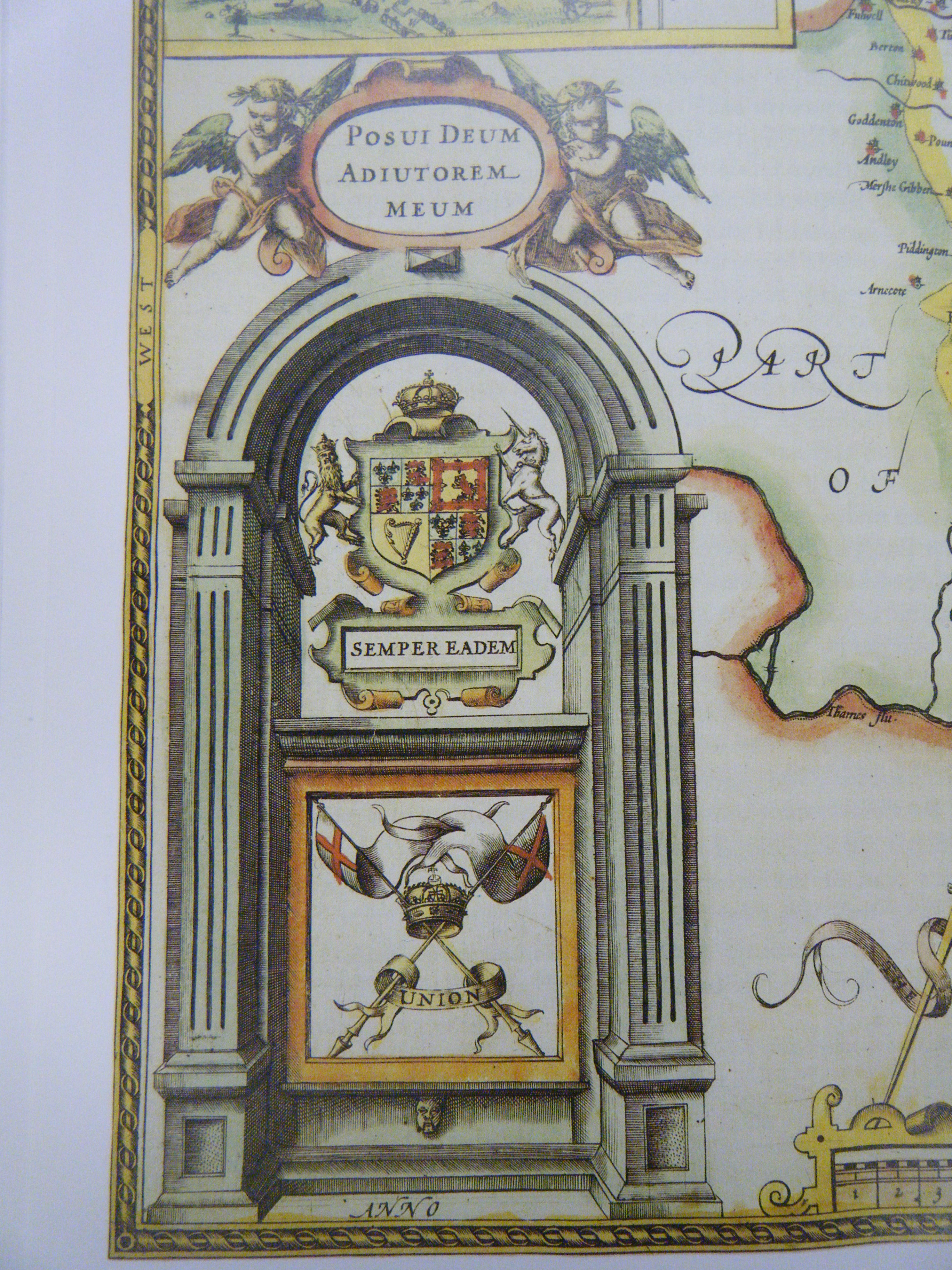
In the Manor House’s Withdrawing Room, there is a map on the far wall across from the rope. This map is small and hard to see from across the room, but up close one can see vibrant colors and beautiful ornamentation. I wanted to point this map out because not only is it beautiful, but also because it is an interesting specimen of maps from the 1600’s. Be sure and click on the images to open a larger view.
I mentioned in the last Featurette characteristics of older maps, if some may recall, which I will be using again in this article. Our map is of Buckinghamshire in England, from 1610. Since this map is 100 years older than our Pennsylvania map (also seen in the last Featurette, follow link above to view), we can see more decoration and the use of mythical creatures.
To begin, in the center of the map is the main map of Buckinghamshire. Noted on the map are man-made features such as towns, cites, and bridges. The towns and cites are marked by a symbol of small buildings with a red dot of watercolor over it. Our mapmaker seemed to use red and yellow watercolors more than the others! These colors are splashed across the crests, fleur de lis, and well-inked lions. Getting back to the central map, the natural features that we placed on the map include hills, mountains, trees, and rivers. The shape of the hills and mountains appear to be anywhere from a bump to a rounded peak, while rivers are a consistent bold line. The trees stand alone at places or are placed in clusters as well on the map.
At the top corners are inset boxes. The box on the left is of Buckinghamshire and on the right is Redding. These insets are like mini maps to important cities and include their own compass, distance scale, crest, and key. They show the roads, river, groups of buildings, fields, and is decorated with oversized farmers and their animals. The key is for the street names which each have a corresponding letter or number on the map. The inset of Redding also labels the South Giles Church and the school in Redding.
Lastly, in the bottom corners are arches. These arches have titles held up above them by two cupids. In the arch on the left is the King’s crest and below are crossed lances and flags with a crown. Across the lances is a banner which reads “UNION”. In the arch on the right are four crests with the title of “The Armes of thofe Honorable Families which have born ye Titles of Buckingha(m)”. The family crests include those of “Walter Gifford Earle, Richard Stanbowe E., Thomas of Wodftoke E., and Humfr. Stafforde Duke”. This map is beautiful and was a symbol of pride for these families to be from Buckinghamshire. If you ever get a chance to see it close up, please go view and enjoy it.
**A big THANK YOU to Danielle Straub for her work on these summer featurettes and helping our curator Todd with his work in Pennsbury’s archives!**
In the second post for our new series The Country Life, we continue our look into the Kitchen Garden’s herb collections (check out our post on Lemon Balm). Here is one you’ll probably recognize…
Rosemary (Rosmarinus officinalis): Recognizable by its needle-like leaves, rosemary had many uses in the 17th century. In the kitchen, cooks could use rosemary to flavor meats (like we do today). Medicinally, its savory aroma was used to ease a headache and to improve one’s memory. Additionally, vapors resulting from steaming the herb could be used to cure an earache and the leaves could be smoked to ease a cough.
William Penn wrote that “a country life and estate I like best for my children,” and we agree! So our new featurette The Country Life will highlight the outside gardens and grounds of Pennsbury Manor and the surrounding area. Enjoy!
Sights, Sounds, and Smells of the Kitchen Garden
Every spring and summer, visitors to Pennsbury stop by the Kitchen Garden to take in the sights and sounds of the 17th Century. They see a multitude of plants of all colors and textures. They hear the birds chirping and the bees buzzing. However, the garden also offers visitors the chance to experience smells of the 17th Century (and I’m not talking about the kind of smells they experience in the stable). The garden boasts a number of fragrant herbs that William Penn may have grown in his own garden. In Penn’s time, the fragrant herbs were not only pleasing, but also useful. Penn’s contemporaries often had several uses for one herb, including culinary and medicinal uses.
Now that school tour season is over, our fragrant herbs will have a change to recover from the rubbing, pulling, and picking. However, kids are not the only ones who are drawn to the sweet and savory smells of the Kitchen Garden. Children and adults alike enjoy the hands-on (and nose-on!) element the Kitchen Garden offers. Here at Pennsbury, we encourage all visitors to engage their senses as they stroll through the garden, including this one:
Lemon balm (Melissa officinalis): A favorite of mine, lemon balm really does smell like lemon! Although it is related to other mints, lemon balm offers a citrus surprise that visitors often do not expect. In Penn’s time it was used to flavor cakes, teas, wine, and other beverages. In fact, our Summer Camp kids discovered lemon balm tea today and loved it! Medicinally, lemon balm was also used to treat a number of ailments from stomachaches to epilepsy.
So take a stroll into the lower kitchen garden and look for lemon balm, it’s near the path intersection by the cistern. Over the next few weeks, we will be sharing more of our most popular and fragrant garden herbs for you to explore. Stay tuned!
The Scene: The Justice Hall in the Old Bailey, London
The Date: 15-16 January 1690
Where’s William? M.I.A. At this stage, Penn was keeping a very low profile in England. He was still suspected by the new King and Queen, William and Mary, of Jacobitism and perhaps Catholicism. Most of his letters now just carry a date, not a location of where it was written, and letters to him were addressed to friends who might know his location, for hand delivery.
Background: Far below the social and political sphere in which Penn maneuvered, there existed a large underclass. This is especially true of the city of London. Many upper class Londoners were quaintly amused by
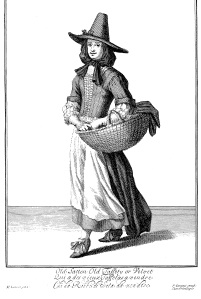
the simple country laboring folk they encountered in journeys across southern England. Closer to home, though, they often objected to the ‘airs’ put on by the lower classes, especially concerning their modes of dress. Fashion, and fashionable clothing, became a London trait, most noticeable after the Restoration, and continuing after the Glorious Revolution. Modes of dress indicated your status in society, and also indicated who could or could notbe approached in public areas. The engraving on the right is one of many in a collection by Marcellus Laroon, an artist who sketched London’s street hawkers, entertainers, and beggars in the late 1600s. These chimney sweeps are from the lowest ranks of London society, and are dressed accordingly. But unfortunately for the gentry, the lower classes started to find plenty of opportunities to buy the fashionable garments traditionally worn only by the upper-classes, causing a major disturbance in the class system. Many women wearing fashionable gowns were now less than met the eye. Bernard Mandeville, writing in the early 18th Century, laments:
This haughtiness alarms the court, the women of quality are
frighten’s to see merchants’ wives and daughters dress’d like
themselves: this impudence of the City, they cry, is intolerable;
mantua-makers are sent for, and the contrivance of fashions
becomes all their study, that they may have always new modes
ready to take up, as soon as those saucy city shall begin to
imitate those in being.
As the merchants wives went, so went the laborers and their wives and girlfriends. They aspired to fashions which would elevate themselves to the merchants clothing status. Men were no different, as you can see from the engraving here. This fiddler sought to elevate his appearance and improve business by dressing in fashionable attire, probably bought used from a street crier. A huge quantity of secondhand clothes abounded in London, both legitimate and stolen. Tradesmen looking to purchase new fashions or servants who receive garments from their employers would sell off used clothing to street hawkers (seen below) for extra money. The hawkers would then resell for a much smaller price than new garments. Clothing and cloth remained a huge black market commodity in 17th – 18th Century England, and most likely, throughout the Empire. This continued until industrialization and its mass-produced, inexpensive clothing caught up with the demand. If fashion or other needs called, and the purse was light, theft would do.
Event: Trials of Anne Hughes, Jane Townsend, Jean Voudger, Ursula Watson, and Mary Smith all before a jury for theft of clothing or cloth in the weeks preceding.
Outcome:
Anne Hughes – found guilty of stealing a number of clothing items from her employer, listed as a “quarter of an ell of Holland value 18 d one yard of Cambrick 3 s. one Scarf 6 d. one pair of Shoes 12 d. “
Jane Townsend – found guilty of stealing one Flaxen Sheet value 5 s. from Joseph Brendon.
Both of these women were sentenced to being “Whip’d from Newgate to Temple Bar” which would have been from above St. Paul’s, and down Fleet Street, tied to a cart, being publicly whipped along the way.
Jean Voudger – found guilty of stealing from one John Rance 56 yards of Flanders Lace value 10 pounds, two Laced Holland Cornets 7 s., two Quoifs 14 s., 2 pair of Gloves, 2s., and twelve Hoods 13 s.
She was sentenced to death for this crime, but was saved from the gallows by reason of her pregnancy.
Ursula Watson – found guilty of stealing a handkerchief and a pair of gloves, and was acquitted of theft charges regarding other items missing from the house.
Mary Smith – found guilty of for stealing six yards of Serge value 12 s. on the 24th of December , from Robert Acton.
Both Smith and Watson were sentenced to being whipped from Newgate to Holburn Bars.
The second-hand clothing market fueled by fashion crazed London was a boon for some, allowing for an apparent increased status to lower class workers (like the crab seller seen above) and employing many. However, it remained a bane to those caught stealing to supply this market and the aristocrats who saw their status as under assault by those up-dressing commoners!




 “
“