
William’s World: A Crime of Fashion!
- July 8, 2011
- Posted By: Pennsbury Manor
The Scene: The Justice Hall in the Old Bailey, London
The Date: 15-16 January 1690
Where’s William?
M.I.A. At this stage, Penn was keeping a very low profile in England. He was still suspected by the new King and Queen, William and Mary, of Jacobitism and perhaps Catholicism. Most of his letters now just carry a date, not a location of where it was written, and letters to him were addressed to friends who might know his location, for hand delivery.
Background:
Far below the social and political sphere in which Penn maneuvered, there existed a large underclass. This is especially true of the city of London. Many upper class Londoners were quaintly amused by
 the simple country laboring folk they encountered in journeys across southern England. Closer to home, though, they often objected to the ‘airs’ put on by the lower classes, especially concerning their modes of dress. Fashion, and fashionable clothing, became a London trait, most noticeable after the Restoration, and continuing after the Glorious Revolution. Modes of dress indicated your status in society, and also indicated who could or could not be approached in public areas. The engraving on the right is one of many in a collection by Marcellus Laroon, an artist who sketched London’s street hawkers, entertainers, and beggars in the late 1600s. These chimney sweeps are from the lowest ranks of London society, and are dressed accordingly. But unfortunately for the gentry, the lower classes started to find plenty of opportunities to buy the fashionable garments traditionally worn only by the upper-classes, causing a major disturbance in the class system. Many women wearing fashionable gowns were now less than met the eye. Bernard Mandeville, writing in the early 18th Century, laments:
This haughtiness alarms the court, the women of quality are
frighten’s to see merchants’ wives and daughters dress’d like
themselves: this impudence of the City, they cry, is intolerable;
mantua-makers are sent for, and the contrivance of fashions
becomes all their study, that they may have always new modes
ready to take up, as soon as those saucy city shall begin to
imitate those in being.
 As the merchants wives went, so went the laborers and their wives and girlfriends. They aspired to fashions which would elevate themselves to the merchants clothing status. Men were no different, as you can see from the engraving here. This fiddler sought to elevate his appearance and improve business by dressing in fashionable attire, probably bought used from a street crier. A huge quantity of secondhand clothes abounded in London, both legitimate and stolen. Tradesmen looking to purchase new fashions or servants who receive garments from their employers would sell off used clothing to street hawkers (seen below) for extra money. The hawkers would then resell for a much smaller price than new garments. Clothing and cloth remained a huge black market commodity in 17th – 18th Century England, and most likely, throughout the Empire. This continued until industrialization and its mass-produced, inexpensive clothing caught up with the demand. If fashion or other needs called, and the purse was light, theft would do.
Event:
Trials of Anne Hughes, Jane Townsend, Jean Voudger, Ursula Watson, and Mary Smith all before a jury for theft of clothing or cloth in the weeks preceding.
Outcome:
Anne Hughes – found guilty of stealing a number of clothing items from her employer, listed as a “quarter of an ell of Holland value 18 d one yard of Cambrick 3 s. one Scarf 6 d. one pair of Shoes 12 d. 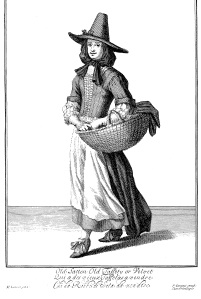 “
“
Jane Townsend – found guilty of stealing one Flaxen Sheet value 5 s. from Joseph Brendon.
Both of these women were sentenced to being “Whip’d from Newgate to Temple Bar” which would have been from above St. Paul’s, and down Fleet Street, tied to a cart, being publicly whipped along the way.
Jean Voudger – found guilty of stealing from one John Rance 56 yards of Flanders Lace value 10 pounds, two Laced Holland Cornets 7 s., two Quoifs 14 s., 2 pair of Gloves, 2s., and twelve Hoods 13 s.
She was sentenced to death for this crime, but  was saved from the gallows by reason of her pregnancy.
Ursula Watson – found guilty of stealing a handkerchief and a pair of gloves, and was acquitted of theft charges regarding other items missing from the house.
Mary Smith – found guilty of for stealing six yards of Serge value 12 s. on the 24th of December , from Robert Acton.
Both Smith and Watson were sentenced to being whipped from Newgate to Holburn Bars.
The second-hand clothing market fueled by fashion crazed London was a boon for some, allowing for an apparent increased status to lower class workers (like the crab seller seen above) and employing many. However, it remained a bane to those caught stealing to supply this market and the aristocrats who saw their status as under assault by those up-dressing commoners!
By Todd Galle, Museum Curator