For reservations to experience “nkwiluntàmën: I long for it; I am lonesome for it (such as the sound of a drum)” by Indigenous artist Nathan Young, please go to https://nkwiluntamen.com/
In November of 1667, William Penn, a freshly converted Quaker, was arrested with18 other Quakers in County Cork, Ireland. Christopher Rye, the Mayor of Cork, was well-known for his persecution of Quakers. In a letter to The Earl of Orrery, one of the lords justice of Ireland, Penn requests that Rye not be encouraged in his persecution.
What is remarkable is that the 23-year old Quaker was already forming and articulating the beliefs that became such an important part of his Holy Experiment:
Religion which is at once my crime and my innocency makes me a prisoner to a mayors malice, but my own freeman, for being in the assembly of the people called Quakers there came several constables, backed with soldiers, rudely and arbitrarily requiring every man’s appearance before the mayor, and amongst many others violently haled me with them. Upon my coming before him he charged me for being present at a riotous and tumultuary assembly…
Penn describes the scene and questions the applicability of the law upon which the Mayor made his arrests. He then appeals to Lord Orrery:
But I presume my Lord the acquaintance you have had with other countries must needs have furnished you with this infallible observation that diversity of faith, and worships contribute not to the disturbance of any place where moral uniformity is barely requisite to preserve the peace… and conclude no way so effectual to improve advantage this country as to dispense with freedom in things relating to conscience.
An astonished Earl Orrery responded that he had already heard about the matter from Rye himself. Orrery wrote, “I confess I was surprised and sorry to see you thus associated ” with Quakers. Orrery forwarded the Mayor’s letter to Penn’s father the Admiral (who had at least twice previously demanded that Penn return to England immediately), and cautions Penn that “you cannot expect that I will hinder the Magistrates from doing their duty. I hope you will follow this friendly advice…”
Looks like young adults defying their parents is nothing new!
Pennsbury is pleased to welcome a new addition to our “Living Collections”: meet Romeo!
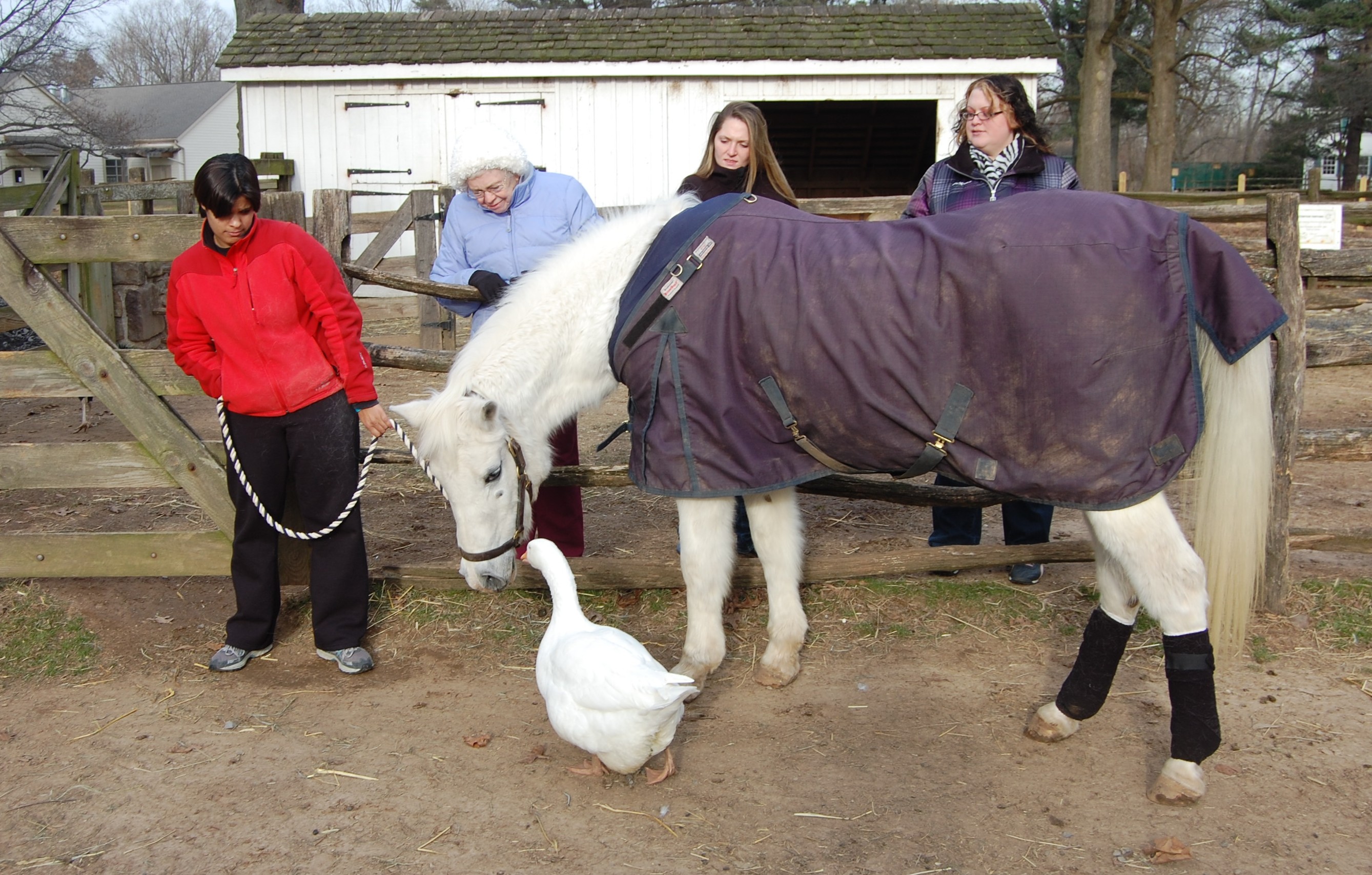
Romeo is a 26 year old white Arabian horse who moved in on Friday, January 6. He comes to us after a long and uncertain road. He worked as a school horse teaching children to ride, which explains his calmness and sweet nature. He spent some time at Special Equestrians in Warrington, then retired about a year ago.
His next owner was, unfortunately, not responsible in the care for Romeo. In October the staff at Special Equestrians learned that he was to be sent to slaughter. One hero in particular, Kaitlin, rushed over and literally took him off the truck and loaded him into her own trailer for a return to Special Equestrians. Kaitlin found that Romeo had lost 300-400 lbs. and that his ribs were showing. Furthermore, he had rain rot (from not being sheltered properly) and an (thankfully easily treatable) fungal infection that was out of control. Kaitlin nursed him back to health, and special equestrians offered use of a stall. But they could only offer the stall until the beginning of January. Romeo’s future was more uncertain than ever.
A Pennsbury volunteer who also spends time with Special Equestrians told us about Romeo. With time running out, we went over to meet Romeo and found a delightful, calm, and people-oriented gentleman. Some generous donors offered to help pay for his upkeep, Romeo’s health was cleared, volunteers worked overtime to ready his new stall, and everything came together for the big move. At first, as Romeo walked off the truck, Maraaca (our current horse), took off in fear. But she soon remembered her manners and the two horses were instant friends. We’ve never seen such a smooth introduction!
Romeo was selected not only for his temperament, but for his looks as well. Arabians are small horses, and our research indicates that many of the horses in early Pennsylvania were under-sized. Romeo is also white and a gelding (castrated male). Records show that William Penn had 2 white mares and a white gelding at Pennsbury Manor.
It is a truly remarkable accomplishment that so many people came together to save a horse, keep Pennsbury’s popular animal program running, and ultimately help our visitors understand the strong link between early settlers and horses. Please stop by this spring (we re-open in March) to meet Romeo and the other residents of Pennsbury’s stables!
I love portraits of people. I can’t help but wonder about the lives behind the faces. When I was new at Pennsbury, I was told that the portrait in the Common Parlor was of Penn’s grandfather, Giles Penn. I accepted that fact at face value (pun intended). But over time I began to question how we know it is Giles Penn, and further, what did the man do to warrant having his portrait painted?
This portrait surfaced in England in 1936. The owner obtained the painting from the Pennington Family. There is a type-written tag on the back of the portrait that identifies the subject as Admiral Penn. However, the man looks nothing like the other portraits of Admiral Penn. Furthermore, the style of clothing in the portrait and the date of 1625 makes this too early for Admiral Penn who was probably born in 1621.
A long tradition suggests that the painting depicts Giles Penn, father of Admiral Penn and grandfather to our own William Penn. That makes more sense, except that Giles would be approximately 24 years old at the time of this painting, and the sitter looks older than that. So maybe the portrait is of Giles, and maybe it isn’t.
So for fun, let’s pretend that it’s definitely Giles. Sitting for a portrait was not a common experience, so clearly he was “somebody.”
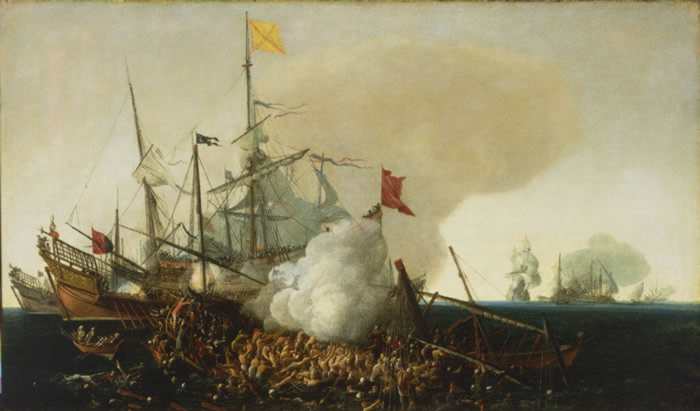
Sanish Men-of-War Engaging Barbary Corsairs, circa 1615
Giles was born in 1601. He became a seaman involved in the highly lucrative and dangerous trade along the Barbary Coast in North Africa. Attacks from pirates became increasingly bold as the 17th Century progressed. By the 1620s, Barbary Pirates were not only attacking ships but raiding settlements along the European coast as far as Iceland. Captives from these raids were sold as slaves in Africa, and tens of thousands Europeans were held. (St. Vincent de Paul and Miguel de Cervantes were among the small number of captives who managed to achieve freedom). Despite the risks, young William went to sea with his father starting at age 10-12.
In 1636, Giles Penn was commissioned by King Charles I to command an attack on Salé in modern day Morocco, where it was believed a thousand Englishmen were held. The attack and blockade was very successful as 339 captives were released. Giles was rewarded with the consulship of Salé where he arrived in 1637 with his 16 year-old son, William. William did not stay in Morocco, however, as we all know. In 1638 William became the captain of his own ship at age 17.
I’d like to share a fascinating video our site director, Doug, just emailed my way. Here at Pennsbury Manor, we talk a lot about life on a late 17th-century farming estate. We offer a wide variety of demonstrations and plant and harvest an authentic kitchen garden every year, but don’t have the staff or visitation to offer a full-scale agricultural recreation. Which is why I find this video series so fascinating!! Click the link to watch the first episode of this 12-episode series where historians work on a real Welsh 17th-century farm for a year: http://www.dailymotion.com/video/xqprv1_e1-tales-from-the-green-valley_lifestyle
Techniques may have evolved slightly by 1683 when William Penn settled at Pennsbury Manor, but not much if at all. The work recreated on this circa 1620 farm is a great way to imagine how early Pennsylvania colonists were surviving!
*No copyright infringement intended, used for purely educational purposes*
I hope everyone has enjoyed a safe and happy holiday season! I love the end of the year, it offers everyone a chance to reflect on the past 12 months and start the next year with a fresh perspective! William Penn’s dream for his new colony was all about living a fulfilled and worthwhile life, and it’s never too late to make a difference.
We have featured some amazing articles this past year on so many different issues and people, and gathered a wonderful following for the blog! I’d like to send out a big THANK-YOU to the staff and interns who have contributed articles this past year. I think we have created a very special resource for our volunteers and anyone with an interest in 17th-century history!!
But this is not meant to be a one-way street – we invite your comments, questions, and discussion! Also if there are any topics you find fascinating and would like to learn more about, please feel free to comment on this post and we’ll try to address it in the coming months!
I wish all Pennsbury’s wonderful volunteers a very happy New Year!
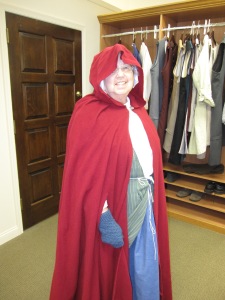
Those that participated in Pennsbury Manor’s annual Holly Nights last week may have noticed a larger selection of winter wear for costumed interpreters. That’s because our Sewing & Mending Society has been working hard the past couple months to create more cloaks, capes, and mitts for our clothing collection! After last year’s bitterly cold event, we wanted to ensure that all our volunteers were as warm as possible.
So I’d like to offer a little background on the 17th-century cloak and all the research that went into our reproductions!
Courtesy of the Metropolitan Museum of Art's Costume Institute
As with all clothing research, we use two main sources to find out how clothing was made and used. They are both “primary” – meaning that they come directly from the period in history, rather than someone else’s later perspective on that period. The first is 17th-century artifacts: garments that have survived from the time. Often these are nicer, upper-class pieces, since they are made from valuable fabric that was inherited by descendents. The early 18th-century piece seen above and below is from Metropolitan Museum of Art’s Costume Institute, which has a wonderful online collection of artifact images (the database can be found here).
Courtesy of the Metropolitan Museum of Art's Costume Institute. Notice the seaming on the bottom edge, seen above - fabric was typically cut in a half-circle or crescent shape, depending on how full they wanted to make the cloak. But if the fabric was not long enough, the remaining scraps could be sewn onto the sides to finish off the arc. Notice the way the back closure has been sewn into place, a variation on the styles seen below. Courtesy of the Metropolitan Museum of Art.
England’s persecution of the Quakers meant that William Penn spent a good deal of time in prison. He wrote a lot of pamphlets defending his beliefs, but also expressed his fervor in poetry. While in Newgate Prison in 1671, Penn wrote and sent this poem to Gulielma Springett. Despite the wording of this poem, Quakers were subjected to serious financial penalties, not the physical torture of the rack!
It is so easy to get caught up in creating the ULTIMATE historical ensemble. We worry about perfecting every detail, down to the smallest buttons and buckles. When costumiers get so caught up in recreating one outfit, it’s easy to forget just how diverse the clothing options actually were! We can’t just recreate one look (as we have done here) and think it will work for all people of all levels in society. Think about the modern world – we can tell a lot about a person’s job or life based on their clothing. Business men and women dress differently than artists or plumbers or teachers or politicians or… well, you get the picture.
So it’s our job as historians to research how those same clothing differences played out 300 years ago. We are developing job-specific costumes for the staff and volunteer interpreters recreating circa 1700 Pennsbury Manor, and working to increase our clothing collection with enough sizes to outfit everyone in the garments they need. Over the next few months, I’ll be posting in-depth tutorials for the different ensembles, but in the meantime I wanted to give you a sneak peak at our work…. enjoy!!
LEFT TO RIGHT: Gardener/Stablehand (Summer); Basic Tradesmen/Estate Worker or Gardener/Stablehand (Winter); Supervising Tradesmen or Estate Caretakers/Visiting BusinessmenLEFT TO RIGHT: Gardener/Stablehand/Cook (Extreme Heat Only - Otherwise with Short Gown worn also); Basic Craftswomen/Estate Workers; House Caretakers/Visiting Women
Continuing our series The Country Life, we feature a lovely and lesser-known herb in the Kitchen Garden. ‘Tis the season for apple cider, apple pie, apple butter… and Apple Mint!
Apple mint (Mentha suaveolens): Like other mints, apple mint was prized for its sweet scent and taste. Besides being a nice addition to any number of baked recipes and salads, it was used to flavor tea, which had a pleasing taste and also helped digestion.
Back in August, recently retired volunteer Penny held a workshop to talk about her favorite hobby: making soap! Penny has been a volunteer at Pennsbury Manor since 1982 – wow! She retired after almost 30 years of soap-making demonstrations, but graciously agreed to provide a soap-making workshop for her fellow volunteers and teach us about her techniques.
To provide a little background information, soap was a necessary all-purpose supply to keep in any 17th-century home. You used the same basic lye soap to wash yourself, your dishes, and your laundry. Alum could be mixed to make a specialty soap for removing laundry stains. Herbs like lavender and lemon balm could also be added for scent. Early Pennsylvanians could have purchased soap at the markets in Philadelphia (or Burlington, NJ which was just down the river from Pennsbury!). But if you had the time, making your own soap would be a good way to save some money.
It was made of two basic ingredients: tallow and lye. Both ingredients were easy to come by – tallow, or rendered animal fat, was regularly available from the kitchen. Penny taught us a modified version of the original Lye Soap process, which I’m happy to share with you now! **Click on images to enlarge**
Penny’s Castile Soap
1. Prepare the Suet
Tallow is made by rendering (melting) animal fat, otherwise known as “suet.” Penny recommends beef suet from around the kidneys, but other animal fats can also work. This would have been easy enough to acquire in the 17th Century, but in the modern world the best place to find suet is your local meat shop. This includes grocery store meat departments. To melt the suet, cut it into small pieces and place in cast-iron pot. I recommend you start with rendering about 1 lb. of suet, as you need 28 oz. of tallow for Penny’s recipe.
2. Render the Suet Add 2-4 inches of water and 2 Tbsp. salt to the suet and place pot on stove-top (or fire if you’re doing this at a historic site). Slowly bring to a boil – you don’t want to heat the pot too fast, or the suet will burn. Allow the tallow to melt off, then remove from the heat.
Place a larger clean pot on the ground and drape cheesecloth or piece of linen across the top. We learned that this works best if the cloth is strapped to the sides with some twine or rope. If working inside, cover the floor with washable cloth or newspapers to prevent any mess or damage.
Then take the pot of melted suet and pour onto cheesecloth. Allow to drain for several minutes, shifting mixture and even squeezing the cloth so all usable fat seeps through. Then remove the cheesecloth and toss the sifted mixture. Congratulations, you now have tallow! Now leave it to cool to 95°-100° F.
3. Making Lye: A Shortcut Penny strongly recommends a shortcut for making lye water, as the 17th-century method is time-consuming and messy. However, if you’re a stickler for authenticity (which we applaud!) and want to go through the original process, you will need to find/create a Leeching Barrel, like the ones you see here (engraving from unknown source).
The leeching barrel would be prepared with layers of straw and ash from the fireplace. By pouring boiling water into the barrel, the lye chemical would be stripped from the ashes and combine with the water, which would drip down into the pot at the bottom. But if you’d prefer to skip this process, Penny picked up some Lye Crystals at her local grocery store. The directions should be provided for specific measurements of hot water and crystals. But first make sure you have the right equipment: rubber gloves, wooden spoon, pitcher that can withstand 200° F, and large pot/bowl/container. Follow the instructions, allowing the crystals to dissolve fully and then leaving the mixture to cool to 100°.
4. Mixing the Soap
Heat 20 oz. olive oil and 16 oz. coconut oil to 95° F. Measure out 28 oz. of the tallow, which should now be the same temperature (if you are short, then repeat steps 1-2 until you have rendered enough tallow).
Combine oils in large pot, then SLOWLY pour lye water into the fats, stirring constantly but gently. The mixture will slowly become the consistency of applesauce. Depending on the tallow used, this could take anywhere from 15 minutes up to an hour.
5. Molding the Soap Gently pour or ladle mixture into mold(s).
You can use any size square or rectangular mold you want. To make an easy mold, find a wooden box (or shoe boxes work great) and line with linen or wax paper to prevent leaks. Depending on the weather and where the molds sit, soap could take a couple days or a week to harden. Warm weather will keep it slightly soft.
6. Milled Soap (optional) To make a more refined soap, you could mill (shave) the hardened soap and remelt and mold. Modern soap-makers often mill their specialty soaps and add in additional scented oils, herbs, and coloring.
**Caution, use fresh soap rather than old, hardened pieces – it won’t melt or dye properly and you could have a crazy time trying to make it behave!!**
Thanks again to Penny for her outstanding dedication to Pennsbury’s visitor programs and volunteer education!!







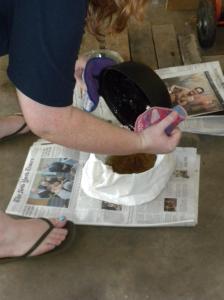 Place a larger clean pot on the ground and drape cheesecloth or piece of linen across the top. We learned that this works best if the cloth is strapped to the sides with some twine or rope. If working inside, cover the floor with washable cloth or newspapers to prevent any mess or damage.