
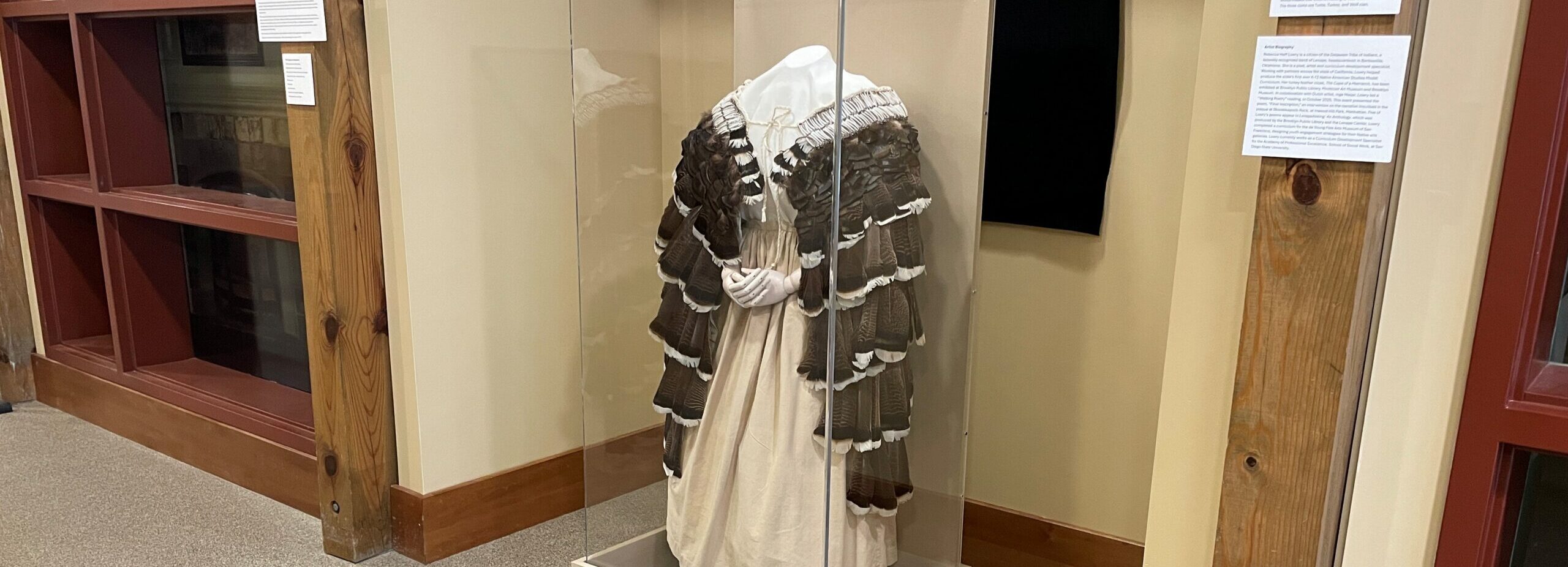
The Cape of a Matriarch

The Cape of a Matriarch (2021)
Artist: Rebecca Haff Lowry
This cape is made out of turkey-feathers woven into hemp netting, and the collar is decorated with dentalium shells and glass beads. Dentalium shells are from sea mollusks, a traditional material widely traded and used by Indigenous artists across the continent.
There were many wild turkeys in Lenapehoking, the Lenape homelands, before European settlers arrived. Turkey-feather garments are an important part of Lenape clothing for men and women, but the knowledge of how to make them became less common as Lenape people were forced away from their homelands.
This cape celebrates the return of Lenape people to their homelands and honors Lenape matriarchs, past, present and future. To make it, Rebecca Haff Lowry learned feather-weaving techniques from her mother-in-law Sandra Lowry, who is a member of the Yurok Tribe, an Indigenous people from northwestern California. Rebecca asked Sandra to sew two-thousand beads into the collar, which symbolizes the Milky Way.
Both Lenape and Yurok people, east and west, belong to the Algonquin language family.

Lenape Art Making Process
Items of beauty are seldom made by one person. Access to materials requires the labor of others, the ability to purchase, gather or trade. Inspiration comes from special relationships with others and designs may be inherited. With large projects, like a feather cape, some family members may help make the netting, while others do the feather weaving.
Lenape people have lived in many different places. Yet they always adapt and use the materials, available to them, to continue the expression of Lenape beauty and ancestral knowledge.

18th Century Lenape Matriarchs
Rebecca was inspired by Lenape matriarchs and the decisions they made to ensure the survival of their families. Historically, Lenape women:
Played important roles in peacemaking. Women directed an end to violence and organized social gatherings to honor the end to violence.
Made and distributed gifts to non-Lenape people in a strategic way. Gifts were given with the intention of remembering and preserving good relationships and mutual aid with neighboring tribes.
Gave gifts to colonists to recognize current agreements and understandings. A very special gift, like a feather cloak, may be given with hope that peaceful cohabitation and friendship may continue.
Played roles in settling land disputes, upholding cultural rules. Ancestral lineage and relationships determine the rights of people to use certain places for hunting, agriculture, gathering, ceremony or habitation.
Decided to accept or reject the efforts of missionaries. Women are responsible for their family, and often lead spiritual practices. They hold social and spiritual roles, determined by their lineage and what was passed on to them.
Made decisions on adoption and made kin out of strangers. “War captives” were often integrated into Lenape communities and did not want to leave when given the opportunity to do so.
Shared visions and knowledge that impacted their community. Use of plant medicine saved lives of Lenape people as well as colonists.
Had equal status. Traditionally, gender was not hierarchal; women were not considered less than men. Individuals who had qualities of both men and women had important roles in cultural traditions.
Had authority, opinions and would assert their voices. Matriarchs helped select the next leaders from their maternal line.
Maintained kinship responsibilities by traveling and visiting thought the vast region of Lenapehoking. Seasonal activities, work and social responsibilities influenced travels and movement. Women’s children often accompanied them on travels.

Lenape Women Today
Lenape women continue the traditional leadership of their ancestors playing active roles in politics, tribal business, education, cultural traditions, revitalization of art forms and renewing relationships in their homelands.

Who are Lenape People?
The Lenape are Indigenous people whose homelands include the areas from what is known today as western Connecticut to Delaware. It includes the areas along the Delaware River and the lower Hudson River Valley. This area also includes what is today known as New York City, New Jersey, and parts of Pennsylvania. In the Lenape language, these lands are known as Lenapehoking, Lënapehòkink, or Lunaapahking. (See map and description here).
The name Lenape means “the people” and are referred to as “the Grandfathers” by other Algonquian speaking people, as a sign of respect. Lenape communities had their own leaders who would be elected by elders and matriarchs (female leaders). The Lenape tribal structure is matrilineal, which means that children belong to their mother’s clan. The three clans are Turtle, Turkey, and Wolf clan.

ARTIST BIOGRAPHY
Rebecca Haff Lowry is a citizen of the Delaware Tribe of Indians, a federally recognized band of Lenape, headquartered in Bartlesville, Oklahoma. She is a poet, artist and curriculum development specialist. Working with partners across the state of California, Lowry helped produce the state’s first ever K-12 Native American Studies Model Curriculum. Her turkey feather cloak, The Cape of a Matriarch, has been exhibited at Brooklyn Public Library, Montclair Art Museum and Brooklyn Museum. In collaboration with Dutch artist, Inge Meijer, Lowry led a “Walking Poetry” reading, in October 2025. This event presented the poem, “Final Inscription,” an intervention on the narrative inscribed in the plaque at Shorakkapoch Rock, at Inwood Hill Park, Manhattan. Five of Lowry’s poems appear in Lenapehoking: An Anthology, which was produced by the Brooklyn Public Library and the Lenape Center. Lowry completed a curriculum for the de Young Fine Arts Museum of San Francisco, designing youth engagement strategies for their Native arts galleries. Lowry currently works as a Curriculum Development Specialist for the Academy of Professional Excellence, School of Social Work, at San Diego State University.