Back in August, recently retired volunteer Penny held a workshop to talk about her favorite hobby: making soap! Penny has been a volunteer at Pennsbury Manor since 1982 – wow! She retired after almost 30 years of soap-making demonstrations, but graciously agreed to provide a soap-making workshop for her fellow volunteers and teach us about her techniques.
To provide a little background information, soap was a necessary all-purpose supply to keep in any 17th-century home. You used the same basic lye soap to wash yourself, your dishes, and your laundry. Alum could be mixed to make a specialty soap for removing laundry stains. Herbs like lavender and lemon balm could also be added for scent. Early Pennsylvanians could have purchased soap at the markets in Philadelphia (or Burlington, NJ which was just down the river from Pennsbury!). But if you had the time, making your own soap would be a good way to save some money.
It was made of two basic ingredients: tallow and lye. Both ingredients were easy to come by – tallow, or rendered animal fat, was regularly available from the kitchen. Penny taught us a modified version of the original Lye Soap process, which I’m happy to share with you now! **Click on images to enlarge**
Penny’s Castile Soap
1. Prepare the Suet
 Tallow is made by rendering (melting) animal fat, otherwise known as “suet.” Penny recommends beef suet from around the kidneys, but other animal fats can also work. This would have been easy enough to acquire in the 17th Century, but in the modern world the best place to find suet is your local meat shop. This includes grocery store meat departments. To melt the suet, cut it into small pieces and place in cast-iron pot. I recommend you start with rendering about 1 lb. of suet, as you need 28 oz. of tallow for Penny’s recipe.
2. Render the Suet
Add 2-4 inches of water and 2 Tbsp. salt to the suet and place pot on stove-top (or fire if you’re doing this at a historic site). Slowly bring to a boil – you don’t want to heat the pot too fast, or the suet will burn. Allow the tallow to melt off, then remove from the heat.
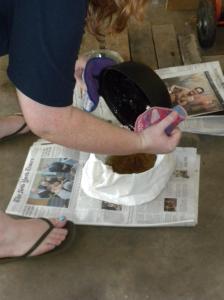 Place a larger clean pot on the ground and drape cheesecloth or piece of linen across the top. We learned that this works best if the cloth is strapped to the sides with some twine or rope. If working inside, cover the floor with washable cloth or newspapers to prevent any mess or damage.
Then take the pot of melted suet and pour onto cheesecloth. Allow to drain for several minutes, shifting mixture and even squeezing the cloth so all usable fat seeps through. Then remove the cheesecloth and toss the sifted mixture. Congratulations, you now have tallow! Now leave it to cool to 95°-100° F.
3. Making Lye: A Shortcut
Penny strongly recommends a shortcut for making lye water, as the 17th-century method is time-consuming and messy. However, if you’re a stickler for authenticity (which we applaud!) and want to go through the original process, you will need to find/create a Leeching Barrel, like the ones you see here (engraving from unknown source).


The leeching barrel would be prepared with layers of straw and ash from the fireplace. By pouring boiling water into the barrel, the lye chemical would be stripped from the ashes and combine with the water, which would drip down into the pot at the bottom.  But if you’d prefer to skip this process, Penny picked up some Lye Crystals at her local grocery store. The directions should be provided for specific measurements of hot water and crystals. But first make sure you have the right equipment: rubber gloves, wooden spoon, pitcher that can withstand 200° F, and large pot/bowl/container. Follow the instructions, allowing the crystals to dissolve fully and then leaving the mixture to cool to 100°.
4. Mixing the Soap
 Heat 20 oz. olive oil and 16 oz. coconut oil to 95° F. Measure out 28 oz. of the tallow, which should now be the same temperature (if you are short, then repeat steps 1-2 until you have rendered enough tallow).
Combine oils in large pot, then SLOWLY pour lye water into the fats, stirring constantly but gently. The mixture will slowly become the consistency of applesauce. Depending on the tallow used, this could take anywhere from 15 minutes up to an hour.

5. Molding the Soap
Gently pour or ladle mixture into mold(s).
 You can use any size square or rectangular mold you want. To make an easy mold, find a wooden box (or shoe boxes work great) and line with linen or wax paper to prevent leaks. Depending on the weather and where the molds sit, soap could take a couple days or a week to harden. Warm weather will keep it slightly soft.
6. Milled Soap (optional)
To make a more refined soap, you could mill (shave) the hardened soap and remelt and mold. Modern soap-makers often mill their specialty soaps and add in additional scented oils, herbs, and coloring.

**Caution, use fresh soap rather than old, hardened pieces – it won’t melt or dye properly and you could have a crazy time trying to make it behave!!**
 Thanks again to Penny for her outstanding dedication to Pennsbury’s visitor programs and volunteer education!!
By Hannah Howard, Volunteer Coordinator