For reservations to experience “nkwiluntàmën: I long for it; I am lonesome for it (such as the sound of a drum)” by Indigenous artist Nathan Young, please go to https://nkwiluntamen.com/
I’m sorry we are so behind in posting November’s Collection’s Featurette, but hopefully many of you have already seen it published in the newsletter…
Delftware Charger
This month’s focus object is a delftware (most likely Dutch) charger or platter. The use of earthenware in the food service realm was widespread both in Europe and the colonies. A healthy trade in tin glazed pottery began by the Dutch and later continued by the English, expanded as the colonies matured and developed. Tin ware, wooden bowls, and pewter were augmented and sometimes replaced by imported delftware as socio-economic conditions improved.
The rapid development of Philadelphia as a trading center would have helped to make such goods available to a wide variety of early colonists. This example is useful in interpreting the rapid development of Pennsylvania as both a colony and an economy desirous of bringing a European style of living to the New World.
This artifact also helps to illustrate the museum collection management and curatorial field. People often ask what a curator actually does. The easiest explanation, and one that Pennsbury staff and volunteers can appreciate, is that curators are stewards. We look after not only objects, but also the track the history of the object, the ‘who, what, where, when, why’ type of information helpful in interpreting that item. In the next newsletter, I’ll let you know what the file tells us about “PM75.127 / CHARGER, DELFT / 4: Food Service T & E” as well as other curatorial considerations regarding the object.
For those that enjoyed reading about the impact of print on society, check out the BBC’s radio program 17th Century Print Culture, which you can listen to at this link: http://www.bbc.co.uk/programmes/p003hycj.
If you have any questions about this subject, just ask in the comments and we can discuss further!
Description: Black printer’s ink etching on cream paper. In armor wearing the seal of the Garter. Portrait is in an oval with panoply of spears and flags above. Cupids in armor below. Painted and sold by Henry Overton, London.
By the end of the 17th Century, printing had become a widespread phenomenon throughout England and Europe. Printing presses, though not much different from the original European version, the Gutenberg Press, had spread like wildfire throughout society. They now printed all manner of goods from leather-bound books to newspapers to cheap penny broadsides, or “catchpennies.” These paper sheets were affordable to the masses and spread news and gossip, especially about politics and public figures. The more sensational the story, the more copies street hawkers could sell. They could even carve sketches onto wooden blocks and insert them into the typeset frame, creating printed images. It could be a double-edged sword for those in power; they could spread their ideas through word and image throughout the country, but so could their opposition.
It had long been tradition for a newly crowned king or queen to pose for a portrait. Many duplicates were made and sent to the country’s aristocrats and ruling families to hang in their homes and public buildings, as a way of asserting the monarch’s authority. Once printing entered mainstream culture, they could engrave a portrait and print hundreds of copies to spread through the lower classes. This image of William III was printed in 1690, only a year after he and his wife Mary ascended to the throne.
William III, Prince of Orange, was descended from the royal family of the Netherlands. His mother was the eldest daughter of English monarch Charles I. He married James II’s eldest daughter Mary when he was 27 and she only 15 years old. When her father ascended to the English throne, she became heir presumptive. Her Protestantism allowed the English to tolerate their Catholic king, knowing he would be replaced. But when his wife gave birth to a son in 1688 – who would be raised a Catholic and start a royal Catholic dynasty – the people rebelled. They believed a rumor that James had brought in a fake son in order to secure Catholic control. William marched to London, determined to safeguard Protestant control, and James was forced to flee to France with his family. William and Mary were crowned joint-rulers of England on February 13, 1689.
They may have been co-regents, but Queen Mary declined to participate in public affairs except when her husband was away. She died in 1694, after only 5 years on the throne. Their marriage had begun badly, but William was reportedly devastated by her death and never remarried.
William’s European world-view was a dramatic change after James’ narrow English-centric perspective. The English people found him to be too cold and serious, and in last years of his reign Parliament refused to cooperate with his requests. The evolution of his reign reflected a shift in the English political system from monarchical government to a more parliamentary system.
by Hannah Howard
For Further Reading:
Brown, Richard. Knowledge is Power: The Diffusion of Information in Early America, 1700-1865. New York: Oxford University Press, 1989.
Sommerville, C. John. The News Revolution in England. New York: Oxford University Press, 1996.
Van der Zee, Henri and Barbara. William and Mary. London, England: MacMillan London Ltd, 1973.
Williamson, David. The Kings & Queens of England. Old Saybrook, Connecticutt: Konecky & Konecky, 1998.
Staff have been really busy working on our new Interpretive Guide which will include a fantastic new layout. We are also going to include some great content on the 20th century perspective that was such a huge influence on the way they did the Reconstruction. Sometimes we forget that “History” is not made of unchanging facts and certainties. History is our PERSPECTIVE of what happened before!
While thinking about how we can talk about this evolution with visitors, I stumbled onto this amazing timeline by Colonial Williamsburg’s Costume Design Center, which celebrated their 75th anniversary last year! They have developed this website feature that goes through their program and the changes that have happened since they started in 1934.
It includes some fantastic images you can click to enlarge, and really highlights how our knowledge and accuracy has improved since we started interpreting historic sites like Pennsbury! Enjoy!
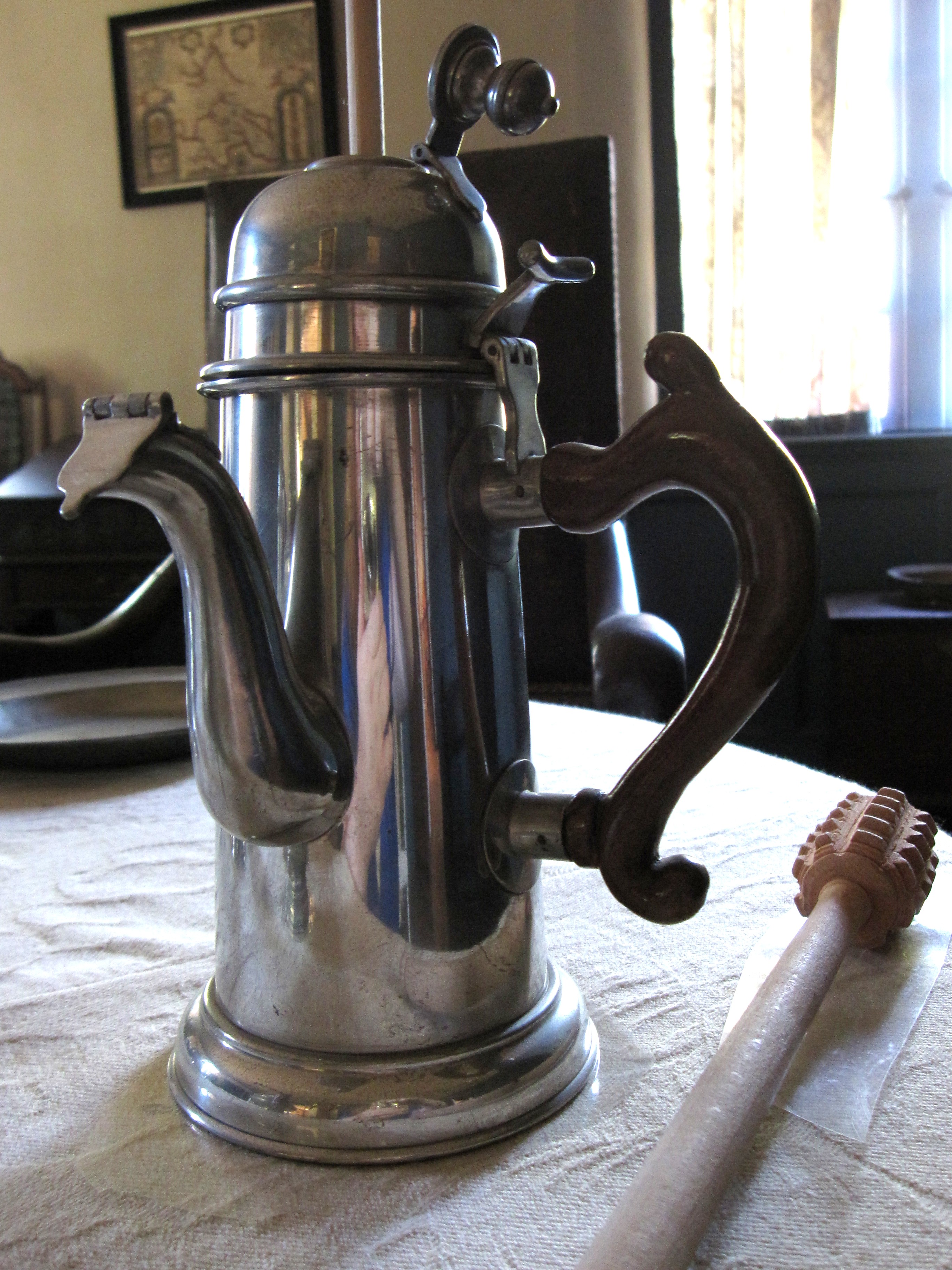
Description: Reproduction of a silver chocolate pot made by John Wisdom in London of English Silver and currently owned by Williamsburg. Has lidded spout and hinged finial.
William Penn’s time in Pennsylvania occurred during the height of drinking chocolate’s popularity. As a member of the upper-class and the governor of Pennsylvania, Penn was not only able to enjoy this fashionable new beverage; he would have been expected to do so. His preference for drinking chocolate and his strong desire to obtain it while he was in Pennsylvania, where it was even more rare than in London, is shown in a letter he wrote in August of 1700 to his associate Logan asking for him to send chocolate to Pennsbury “by all means, if to be had”.
Chocolate is made from the beans of the cacao tree, which have naturally bitter taste. The general method of preparing them for consumption began with them being dried, peeled, and slowly heated, usually using some sort of iron plate. Next, an iron roller would be used to sweeten the cacao by mixing in things like sugar, cinnamon, nutmeg, vanilla, ambergris or musk to be made into small cakes. Drinking chocolate could be made from these cakes by scraping off flakes and mixing them with a liquid such as milk or mulled wine. Eggs would then be mixed in with the liquid and stirred with the mill (a wooden stick with multiple notches around one end) to thicken the drink. Other commonly added ingredients were honey, salt, and flour. Flour served to take up some of the fat from the thickening of the liquid in order to make the beverage easier to digest. The resulting chocolate drink would have been richer than modern day hot chocolate because it contained the full measure of the bean’s cocoa butter. The type of pot which contained drinking chocolate was generally practical in form with straight sides, a domed cover, and an opening to insert the molinet (a wooden stick used to stir and mix the thick drink).
The cacao tree is generally thought to have originated from the Amazon in South America and spread to the surrounding regions by man. The earliest evidence of the beans use for consumption is from as early as 1100 B.C.E. with cacao residue found on pottery in Honduras. However, it wasn’t until Cortez conquered the Aztecs in the early sixteenth century that chocolate was discovered by the Spanish, who then brought it to Europe.
Production and distribution of chocolate did not emerge in England until after 1655, when the British capture of Jamaica and its cacao plantations made the cacao beans available for trade. Once there, the popularity of chocolate exploded with the first chocolate houses appearing just two years later in 1657. Chocolate, along with coffee and tea, brought caffeine to Europeans for the first time, creating an entirely new type of beverages which were non-alcoholic and served to stimulate the mind and body. Due to the fact that the beans could not be grown locally and had to be imported from far away, chocolate was extremely expensive: when the first chocolate house opened in 1657 its price per pound would today have been somewhere between 50 and 75 USD. This meant that chocolate was a luxury reserved for the upper class until the invention of the steam engine in the late eighteenth century enabled its mass shipment across the continents. It continued to find favor with consumers, establishing itself as the favored morning beverage of the elite to be enjoyed daily with breakfast. Drinking chocolate reached was at the height of its popularity during the late seventeenth and the early eighteenth centuries, but had largely been discarded in favor of tea by the end of the next fifty or so years.
The Wm Penn Sewing & Mending Society will be holding its first session in the Crozier House this Saturday, August 21 from 10am-2pm! We hope that this will be only the beginning of a fun and productive program at Pennsbury, and there is room for anyone willing to help out. We need beginners and experienced sewers and anyone willing to learn how to make lucette string, so please join us and lend a hand!
As a special treat, I am including this link to an interactive game by Colonial Williamsburg! It’s based on clothing from 75 years after Pennsbury’s time period, but it’s similar in many ways and you can see how clothing evolved between Penn and the Revolution. Have fun!
Description: Two handles and spouted. Birds and flowers in underglaze blue on white grounds. Central gooseneck ceramic spout. Bristol Delft.
There are two posset pots in the Manor House, located in Hannah’s Closet and the Great Hall. A posset is a type of alcoholic beverage or dessert, similar to modern eggnog, made with cream, eggs, sugar, wine, and cinnamon or nutmeg. Served hot, this sweet treat had three layers: a foamy top layer followed by spicy custard, usually eaten with a spoon, with a strong alcoholic liquid at the bottom, which would be sucked out through a straw.
Possets served ceremonial, medicinal, and social purposes. Traditionally they have been drunk for the celebratory toast made at weddings. Medicinally, possets were used as a cure-all treatment for minor ailments such as the common cold. They could also be present in social settings, as a nourishing and easily digestible beverage consumed in a relaxing or retiring setting.
Possets were served in their own specialized container, a two-handled spouted ceramic mug called a posset pot. Posset pots were usually made of delftware with little variation in their blue and white painted glaze decoration. This particular posset pot originated circa 1700, during the peak of delft popularity, from Bristol Deft which was the epicenter of delft production.
Delftware, also called limeware, Holland ware, and galley ware, is a type of earthenware that was coated in a lead glaze and tin ashes to make it clear so it could then be decorated with colored pigments of which blue was the most common. It originated in eastern Asia and spread to Western Europe in the 16th century. Due to its origins, delft design frequently imitated Chinese porcelains and reflected the growing popularity of Asian-inspired decoration. European colonization of that region meant a major influx of goods from the Orient which made an impression on the British culture. Delftware production in England began 1567, after which the center of production soon moved from Holland to England- particularly London and Bristol. The popularity of delftware grew by leaps and bounds in the American Colonies, becoming the most common type of ceramic export from the sixteenth to eighteenth centuries.
by Rebecca Remmey
Further Reading:
Belden, Louise Conway. The Festive Tradition: Table Decoration and Desserts in America, 1650-1900. New York: W. W. Norton & Company, Inc., 1983.
Day, Ivan. “Possets”. Historic Food. Ivan Day, 2003. http://www.historicfood.com/Posset%20Recipes.htm. Digby, Sir Kenelm. The Closet of the Eminently Learned Kenelm Digby Knight. London, 1670.
We’ve again made it onto the Trailheads blog! This time they are featuring interns from different sites, so click the link below and scroll down to hear the lovely quote by Jenn, our amazing summer intern!
Pennsbury Manor has been featured in the Trailheads blog! This blog focuses on offering behind-the-scenes peaks into PHMC Historic Sites and Museums. Check out their article on Pennsylvania cell phone tours, which includes a small blurb on our own program: http://patrailheads.blogspot.com/
Every 4 years, members of the local Rising Nation group and community supporters travel the Delaware River from New York to Cape May. In part, the trip is designed to promote the awareness that the Lenape people living in Pennsylvania are carrying on their traditions, culture and spiritual beliefs.
This year they will be stopping here at Pennsbury, and so we would like to invite our volunteers to join us on Thursday, August 12 around 5pm for a potluck dinner with the canoers! Their arrival time is hard to pinpoint – they expect to arrive around 4:00, so we will gather by the river around 5:00 for a casual meal and some great conversation.
Please RSVP to Hannah (c-hahoward@state.pa.us) or Mary Ellyn (mkunz@state.pa.us) by Saturday, July 31 if you are interested in coming! Again, this is only open to volunteers and their immediate families.